
Q&A with 9 AI Power Users
Part 2 of 2
What you’re about to read is likely something you already sense, though it’s not easy to put into words.
As I see it, it’s a call for individuality and for collaboration.
The opportunities ahead for freelancers, micro businesses, and small collectives are immense and already within reach. There are risks, and some of them are already considered in the following paragraphs.
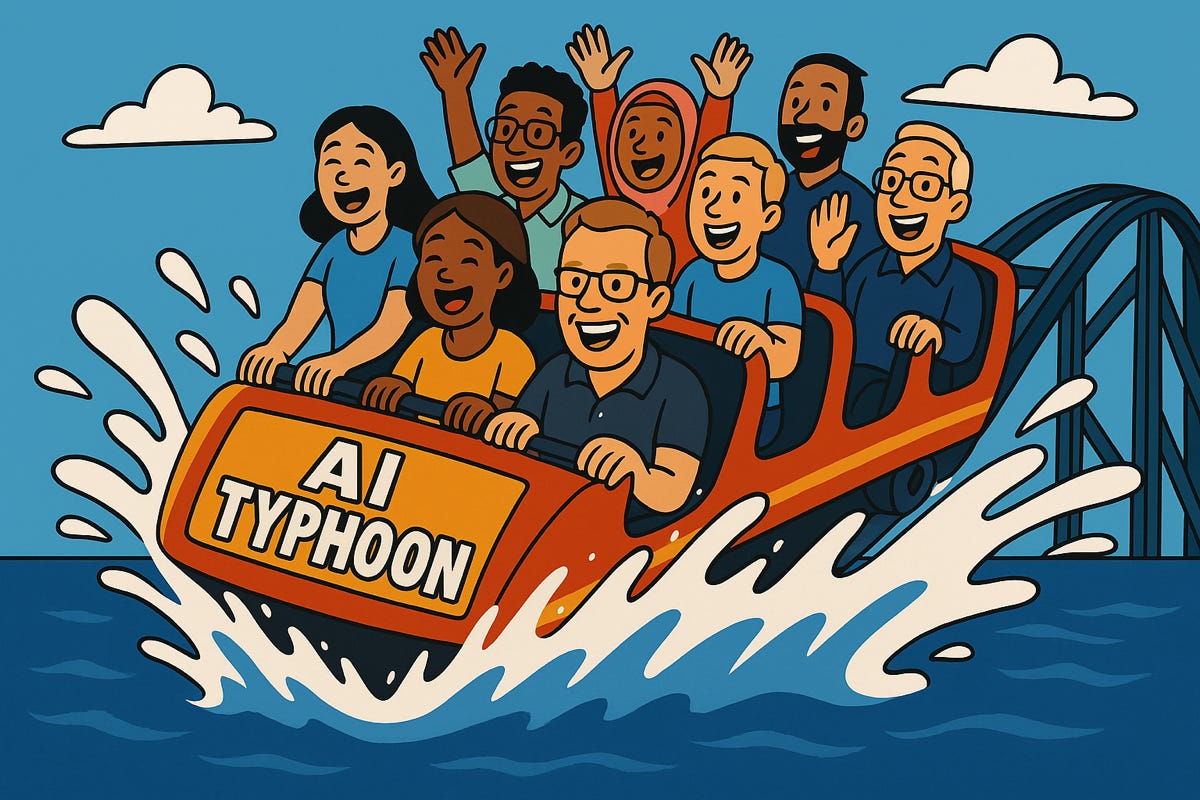
So, fasten your seatbelt and enjoy the ride!
If you haven’t…
Let me reintroduce you to the 9 AI Power Users
, , , , , , , ,If you haven’t read part 1/2 of this series, here it is:

How do you see AI and other smart tools shaping the competitiveness of small teams and businesses?
I’ll let you with the quotes directly:
“…HUGE competition now. Really need to stand out. There is really no more Unique Value Proposition, but we need to have a Competitive Value Proposition. The best defense is to build a STRONG personal brand moat around yourself. Bring humanness into your business.” —
“… Now the norm is small teams achieving milestones that were possible before only for large companies and corporations… it’s going to level the playing field. The advantage won’t be more output in less time, it would be better usage of what’s available and better discernment of what to do, when, and most importantly, why. —
Small teams with deep expertise can now ship what used to require entire departments. AI compresses the overhead, but you still need domain knowledge and good judgment, it’s a force multiplier, not a replacement for thinking. —
…Those that adapt can drive more revenue, for less marginal costs, and make more money on the bottom line. They can move quickly, serve more customers digitally, and have more concurrent product/revenue lines. Skills shift is rapid but not like learning to code or learning a new language - it’s horizontally available regardless of background or financial situation. —
“Small teams that know who they are, what they stand for, and how they think will move with a kind of precision large organizations can’t match. When execution is abundant, coherence becomes the differentiator.
The real edge won’t come from faster production, but from reflective integration, from teams that use AI as a cognitive amplifier, not a content factory... The winners won’t be the ones who automate the most, but the ones who stay most human in how they automate.
But this requires a different kind of leadership, less chess master, more gardener. Leaders will need to build environments of trust where curiosity is safer than compliance, where people are invited to explore, not managed through control…”
—
How Optimistic are you about the future of AI?
The number ten indicates a high level of enthusiasm about the future of AI. As you can see, our nine Power Users are pretty enthusiastic. But it is possible to see some signs of “cautious enthusiasm.”
You have to consider that our Power Users have already adopted AI, which means that it is perfectly reasonable to see other people reacting against AI. We need all the opinions so we can create the best scenario possible.
How do you deal with the overwhelming hype around AI?
Yes, let’s chill! It is easy to get overwhelmed, narrowly focused on learning and getting the best of this new trend. We must pause and see the situation for what it really is: an opportunity for growth and development. If we see it only as a competition, we might get lost.
What is your best advice for someone just starting with AI?
Our Power users are sharing wisdom here.
We are so used to working the way we do that we don’t consciously know our workflows. This can help. Why is this so important? because that is the only way we can learn what can be automated.
There is emphasis on knowing that AI is the tool, we are in charge, and responsible for the outcome of our work.
Final reflections
This is what our Power Users want you to consider:
“The [goal] of all of my work with clients is FOCUS.
Everybody is an expert in AI, and they [are trying] to sell the next best AI tool.
Just find a couple [of tools] that make your life easier and dive into them. Don’t try to learn 10 of them, and [avoid] switching to the next shiny object.” —
“AI reflects the intent behind its use, without clear leadership and purpose it is just a noise. Your mission must be the compass.” —
“I am [an] optimist about [the] improvements in AI and tech in general. I’m not optimistic about human nature and how we’ll be using that tech or let that tech be used against us.” —
“Your ideas deserve to exist in the world, not just in your head. Get your hands dirty, iterate fast, and build systems instead of reacting to problems, that’s how you scale up without burning out.” —
"If you’re reading this quote in 10 years time you’ll either be the Boss of AI with a predominantly AI workforce or an AI will be the Boss of you. You decide."
—
Never let AI do your work for you. Use it as a powerful thinking partner to edit and augment your own storytelling, experiences, and capabilities. —
“Most of what we call “AI adoption” isn’t about technology, it’s about remembering how to be human while everything around us accelerates. We keep looking for prompts, frameworks, and shortcuts, but what this era really asks for is posture: the courage to stay reflective when everything else rewards reaction.
Everyone is asking the wrong question, is AI the best healer, just an algorithm, the smartest assistant, the most intelligent model? But intelligence doesn’t live in the model. It lives between us and the model, in the relational field we co-create when we engage with it. The system isn’t just the AI. It’s the human, the machine, and the quality of attention flowing between them.
AI won’t replace us. It will amplify whatever already drives us — our clarity or our confusion, our empathy or our ego. The real question is whether we can stay coherent enough to shape that field consciously. Because the future won’t belong to those who use AI best, but to those who relate to it most wisely.” —
After all that fantastic input, one thing is clear: AI is here to stay.
It’s already transforming the way we work, across every field of human activity.
From pharma to the creator economy, from schools to NGOs, it’s everywhere.
What matters most now is how we adopt and adapt — keeping responsibility for our work and staying focused on creating real value with a human touch.
What’s your take?
Love,
Jose
Thanks for including me on this roundup!
Having been through multiple tech bubbles & crashes, I look forward to a time when we just get on with delivering value, and AI becomes part of our toolset rather than the only topic of conversation 24/7.
I align closely with Jenny Ouyang’s wise take:
“AI compresses the overhead, but you still need domain knowledge and good judgment, it’s a force multiplier, not a replacement for thinking.”
Wow! Amazing article. I’m truly honored and humbled to be listed among these amazing humans.
The most valuable advice is to slow down where everyone is trying to speed you up. And… keep it human 🔥