
Let's Own Our AI Stack
For makers, builders, knowledge workers, and freelancers using AI for life and work

TL;DR: When working with AI, own your work, your process, and build for platform independence. In this article, you'll find my research, the tools I found, the concepts we all need to master, and the standards, tools, and technologies that exist to help us achieve Digital Sovereignty. Especially useful for non-tech people looking to level up their AI skills. A warning: I'm overly critical of US AI models like ChatGPT and Claude — but don't let my opinion spoil the value this article shares.
As you know, I’m worried about the AI zeitgeist. The market buzz gravitates around commercial models like ChatGPT and Claude, and that limits the AI panorama for the majority of users, especially the non-tech among us.
I have been talking about Digital Sovereignty for a few weeks now, so I decided to research what other options we have to keep learning to use AI as a tool that genuinely benefits our business, our professional growth, our learning process, and our quality of life.
In this article, I’ll show you what I found. To be honest, I didn’t know where to start.
What I found, with the help of some friends, is useful to everyone, and it might hint at a few business opportunities that are still waiting to be built.
Who gets the best of AI right now?
I honestly believe IT professionals, developers, and software engineers are the ones getting the most out of AI today. And to my surprise, they’re using multiple LLMs for different parts of their workflows, some local, some hosted, mostly open-source tools, and yes, Claude and ChatGPT too, mainly for coding.
It's genuinely impressive.
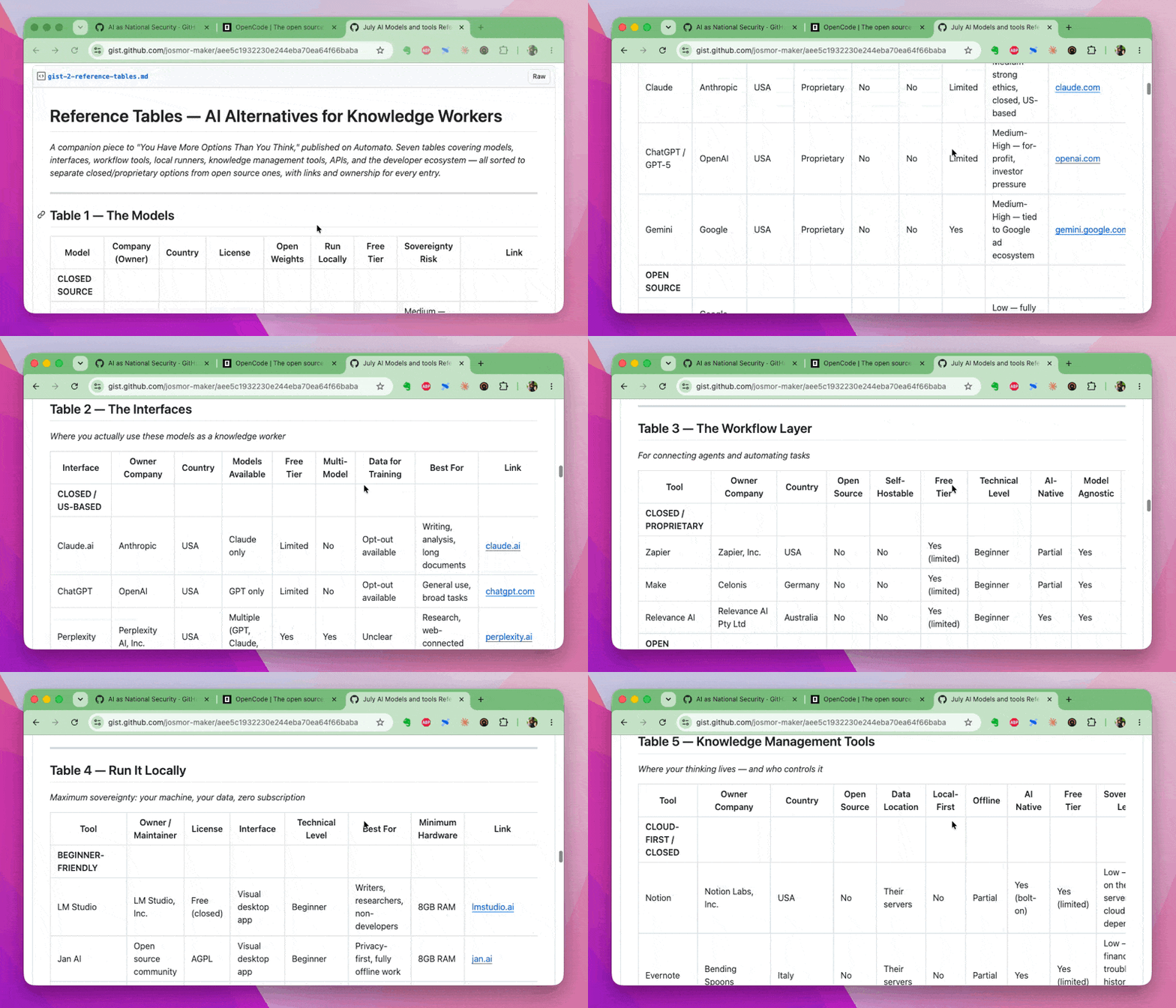
So I mapped the whole thing: 7 tables covering models, interfaces, workflow tools, local runners, knowledge management, APIs, and the developer ecosystem. All linked at the end of this article.
What is the real problem with commercial US LLMs?
OpenAI, Anthropic, and the others are bound by US law — and AI is now being treated as a strategic national security technology. The entanglement between these companies and state power goes further than most people realize: Pentagon contracts, military operations, targeting systems. I’ve been writing about this separately, and I’m not going to apply a lighter standard to Chinese models either — open weights don’t automatically mean political neutrality.
The full story, with quotes and sourcing, is here: Who Really Controls Your AI? — The US and China Question.
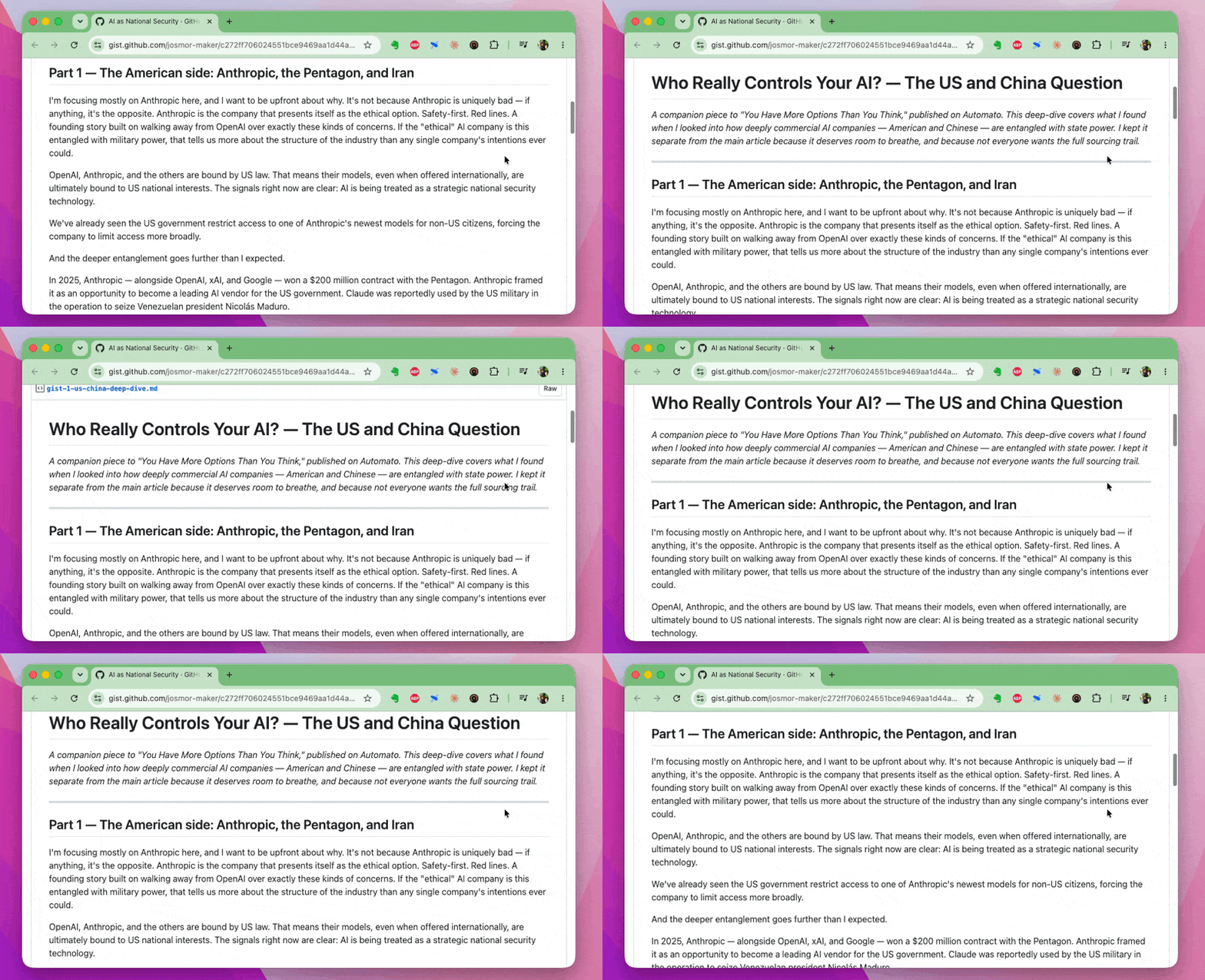
The short version: sovereignty isn’t one thing. It’s at least two — who controls the infrastructure, and who shaped the worldview. Nobody is winning cleanly on both. Keep that in mind as you read the rest of this.
Ok, so what do we get if we decide to step away from US LLMs and tools?
First, we need to understand something important:
Any tool, app, skill, or automation we build with AI should be easy to transfer to other models. We should avoid getting locked into any single LLM.
And yes, I know ChatGPT and Claude, in particular, are extremely good at shipping new features that make our imaginations fly.
Researchers studying AI adoption have found that this kind of dependency is categorically different from traditional software lock-in. The dependency isn’t just functional; it’s cognitive.
When you build your work around a specific model’s behavior, its tone, its reasoning patterns, the way it responds to your prompts, you develop implicit knowledge that doesn’t transfer easily to another tool.
Build your AI tools, for your business and for yourself, with independence in mind.
The other thing we get is access to open-source models and tools. But we need to learn more about what that actually means.
What “open source” actually means, and why it matters to us
Before looking at specific tools, there’s a distinction worth understanding: the difference between open weights, open source, and self-hostable.
Closed source means a company runs the model on their servers, you send your data to them, and you have no visibility into what happens with it. Claude and ChatGPT fall into this category.
Open weights means the mathematical parameters of the model are publicly available. You can download them, study them, and run them on your own hardware. This is the most important form of openness for sovereignty purposes.
Open source goes further — the training code, data pipeline, and methodology are also public. Fewer models meet this bar fully.
Self-hostable means a model small enough to run on consumer hardware — a laptop or a modest server — without needing a data center.
The sovereignty insight is simple:
A model with open weights that you run locally sends zero data anywhere. Your conversations stay on your machine. No subscription. No terms of service changes. No provider deciding tomorrow that your use case is no longer supported.
But “open source” doesn’t automatically mean free or safe. A model with open weights hosted on a Chinese company’s API still sends your data to their servers. The weights are open; your usage is not.
The landscape — what actually exists
The closed models: familiar but bounded
Claude (Anthropic, USA) and ChatGPT / GPT-5 (OpenAI, USA) are the tools most knowledge workers already use. They’re genuinely the most polished, the best integrated into professional workflows, and the most studied for safety.
The trade-off is complete dependency, no local option, no open weights, full data exposure to US companies operating under US law, investor pressure, and now, apparently, defense contracts.
Gemini (Google, USA) sits in the same category, closed, cloud-only, tied to one of the world’s largest advertising businesses.
The open models: what you didn’t know existed
Gemma 4 (Google DeepMind, Apache 2.0) — Google’s open-source family, released April 2026. The irony is striking: the same company whose closed Gemini model collects your data also releases a fully open model you can run locally with zero data sent anywhere. Gemma 4 is multimodal, powerful, and available on Ollama and LM Studio with a few clicks.
Meta LLaMA 4 (Meta, USA, custom license) — the most widely deployed open model family in the world. Excellent quality, enormous developer ecosystem, downloadable and locally runnable. The license has one restriction: companies above 700 million monthly active users need special permission. For a knowledge worker or small business, this is irrelevant.
Mistral Large 3 (Mistral AI, France, Apache 2.0) — the only serious Western open-source contender. A Paris-based company releasing fully open models under the most permissive license available. It doesn’t win every benchmark. But it’s European, auditable, and self-hostable — which matters differently than winning a benchmark.
Then there’s the Chinese wave — and it’s worth paying attention to:
DeepSeek V4 (backed by High-Flyer Capital, China) — the model that shocked markets in early 2025 by matching frontier US models at a fraction of the training cost. Open weights, locally runnable, genuinely capable. The sovereignty question here is nuanced: the weights are open, but using their API sends your data to Chinese servers.
Qwen 3 (Alibaba Group, China, Apache 2.0) — Alibaba’s open model family, consistently at the top of open-source benchmarks. Available locally. Free to download and run.
GLM / Z.ai (Zhipu AI, China) — Beijing-based, state-adjacent, but with open weights and a free interface. A capable alternative for general tasks and research.
MiMo V2.5 Pro (Xiaomi, China, MIT license) — yes, the smartphone company. Xiaomi released a trillion-parameter open-source model in April 2026, under the most permissive license available. The fact that the company making your $200 phone is now shipping frontier AI that competes with Claude is, in itself, a sovereignty argument.
Kimi K2.6 (Moonshot AI, China, modified MIT) — the most interesting model for knowledge workers specifically. Moonshot has built Kimi Work, a platform that integrates document creation, research, spreadsheets, presentations, and web research into one interface powered by an open-source model. It’s the closest thing that currently exists to a knowledge-work equivalent of the developer tools dominating the open-source AI conversation.
MiniMax M3 (MiniMax, backed by Alibaba, China) — strong models, but worth noting that recent versions have moved away from fully open weights toward API-only access. A reminder that “open source” is not a permanent promise.
A reminder on all of the above: open weights solve the infrastructure problem, not the worldview problem. I went deeper on what that means, with sourcing, in the companion piece linked earlier in this article.
What is the opportunity I mentioned before?
Almost everything being built right now is for developers.
Developers today have purpose-built platforms that give them access to multiple open models through one interface, a cockpit designed for their kind of work.
OpenCode, for example, bundles access to GLM, Qwen, Kimi, MiniMax, and DeepSeek for $10 a month, all in one place. Tools like GitKraken complete the picture, giving developers visual control over their entire codebase alongside their AI workflows.
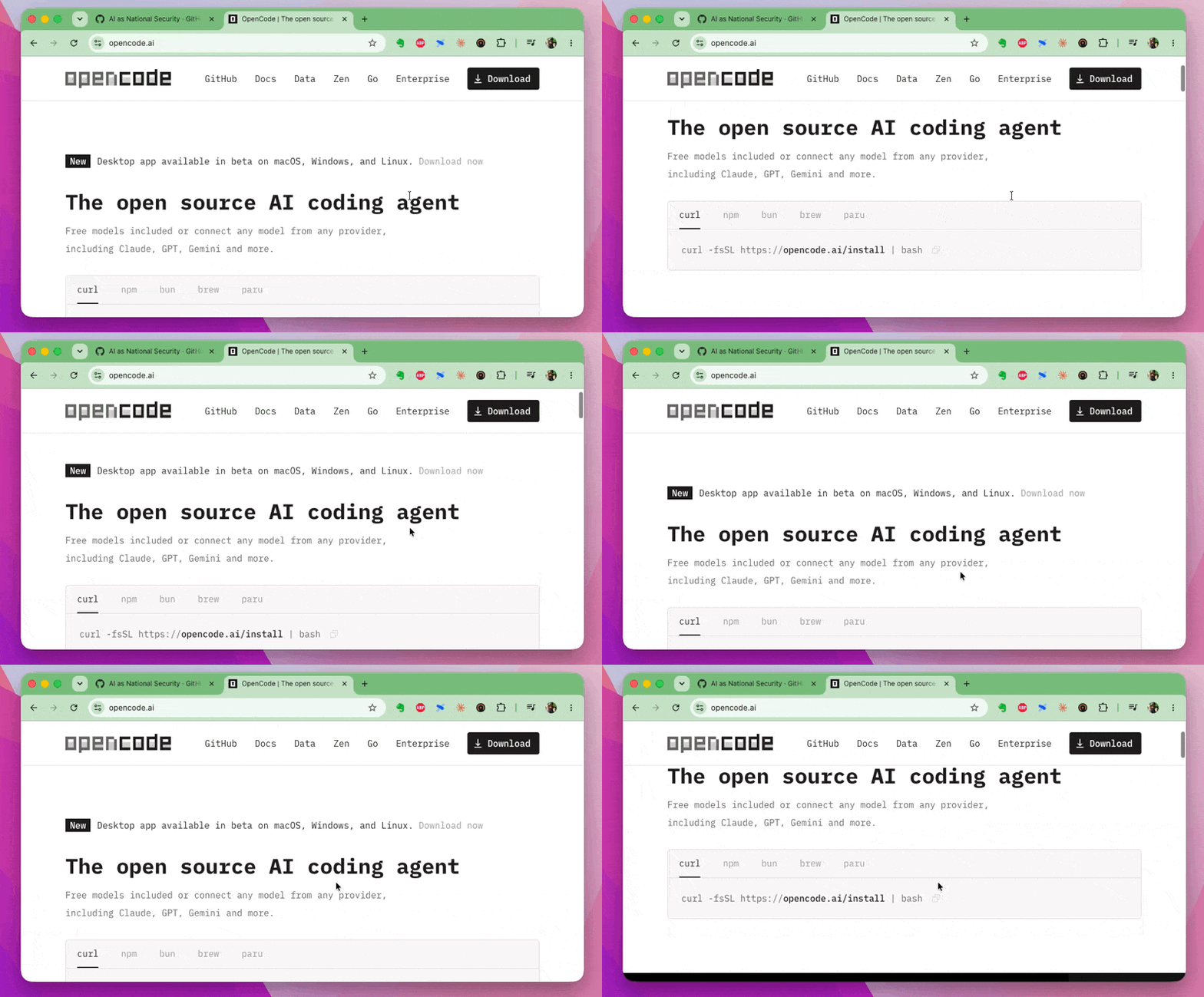
There is no OpenCode for writers. There’s no equivalent for consultants, researchers, or independent professionals who want to chain multiple AI tools together for non-coding tasks.
The closest things that exist for knowledge workers are Poe (Quora, USA — a multi-model interface that lets you switch between Claude, GPT, Mistral, LLaMA, and others) and Perplexity (Perplexity AI, Inc., USA — an answer engine combining web search with multiple models). Both are useful. Neither is open. Neither is European. Neither gives you true sovereignty.
models.dev is worth bookmarking as a reference — an open-source database that lets you compare every major model across pricing, context limits, open versus closed weights, and capabilities. Not a tool to use, but a map to consult.
When was the last time you heard about n8n?
I find less and less new content on good practices for orchestrating agents for non-tech people. And Claude’s marketing machinery has convinced me, almost successfully, that I can do nearly anything using Claude exclusively.
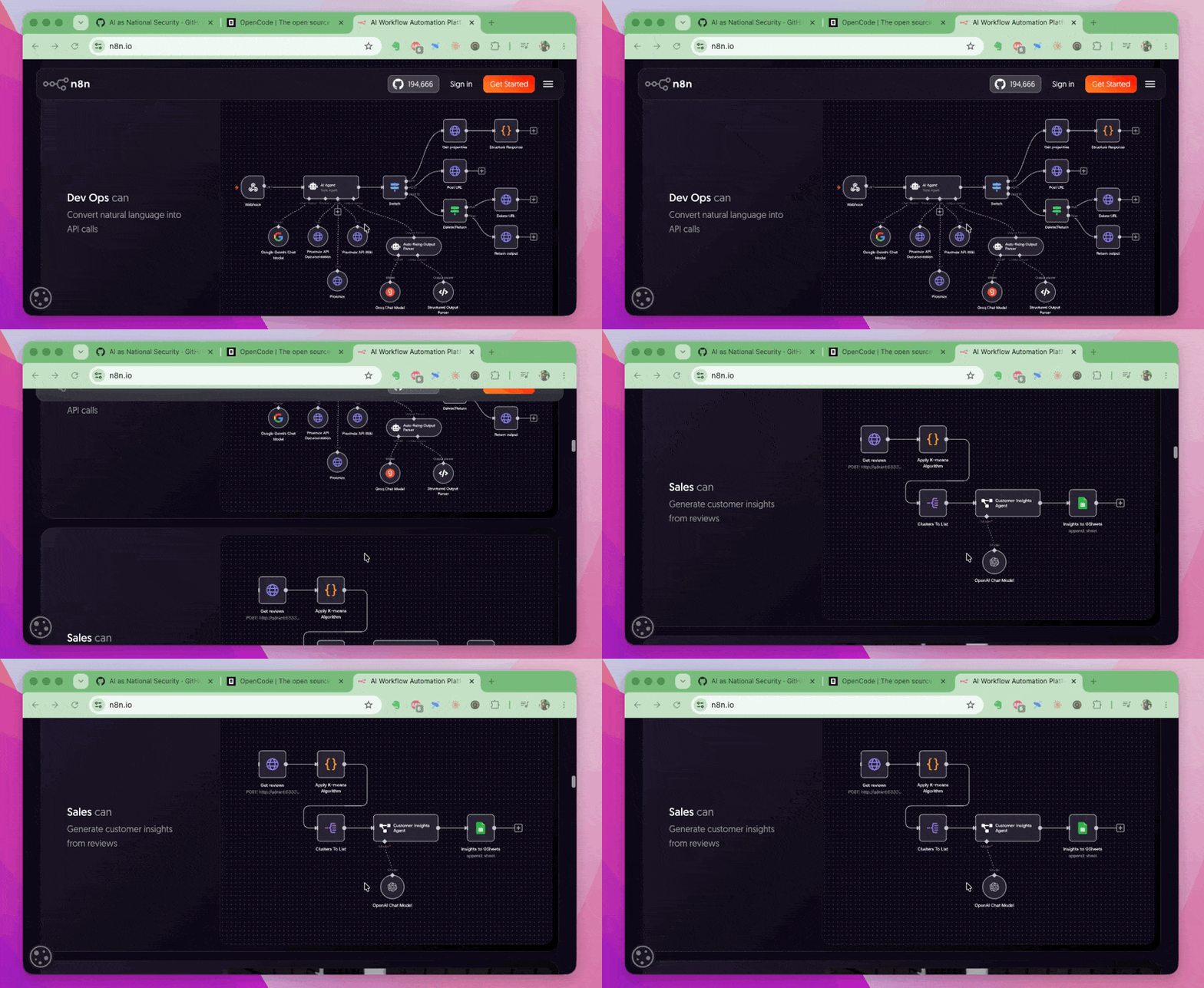
So I started wondering: how can I use some of the best practices that advanced AI engineers rely on, for my own non-technical work?
Can I integrate other tools for managing agents?
Workflow automation tools connect applications, trigger actions, and chain outputs so that one agent’s result feeds the next.
For developers, this ecosystem is rich: LangChain, CrewAI, AutoGen, n8n with AI agent nodes. For knowledge workers, it’s thin but growing.
n8n (n8n GmbH, Germany) is the most relevant option for sovereignty-conscious users. It’s open source, self-hostable, has a visual interface, and has native AI agent nodes. You can build a workflow that triggers a research task, processes the output with a model of your choice, stores the result in Notion, and drafts a newsletter — without writing code, and without sending your data through a single US company’s infrastructure.
Make (Celonis, Germany/Czech Republic) and Zapier (Zapier Inc., USA) are the more accessible options — easier to start with, but closed and cloud-only. Activepieces (open source) is a newer alternative worth watching.
But here’s the warning I want to leave with you about this layer:
The automation trap is real. Building workflows because you can, not because you need to, is just moving the dependency from a model to a process. I’ve built automations that seemed powerful and turned out to be unnecessary. The question is never “can I automate this?” The question is “what output do I actually need?” Start from there. Work backwards. Sometimes the answer is a workflow. Often the answer is a clear prompt and some time.
Let’s not forget MCP
If you do build workflows or tools, there’s a protocol worth knowing about. MCP stands for Model Context Protocol. It is an open standard, created by Anthropic but now adopted across the industry, that lets AI models connect to external tools and data sources in a standardized way.
What this means in practice:
The connections and workflows you build are potentially portable. You’re not building inside any single company’s ecosystem. You’re building on an open standard that an increasing number of platforms support. And if you build something that works well, you can make it available to others; your workflow becomes a contribution.
4 questions we should not forget
This is the sovereignty framework I use now. It applies to Claude, to ChatGPT, to every tool in this article, and to every tool that will be released after it.
Who owns what I put in? Read the terms of service. Understand whether your documents, conversations, and creative work are used to train future models. Know whether you can delete your data, and whether deletion is real.
What happens if I stop paying or they change their terms? Every tool you depend on can change pricing, deprecate features, or shut down. If that happened tomorrow, what would you lose? Can you export your work in a format another tool can read?
Can I take my work somewhere else? This is the portability question. Your accumulated context — preferences, custom prompts, the memory of your projects — lives inside platforms that don’t interoperate. The closer you get to open standards and open formats, the more of that context you actually own.
Whose worldview is built into this model? This is the question I almost skipped. Every model — closed or open, American or Chinese — was trained somewhere, under some legal system, by people answering to someone. Sometimes that shows up as a server-side filter you can route around. Sometimes, as we just saw with Chinese open-weight models, it’s baked into the weights themselves and follows the model even offline. Ask what topics a model avoids, deflects on, or has a suspiciously uniform opinion about. That tells you something no benchmark will.
An invitation: slowly, slowly…
Let’s start breaking dependencies.
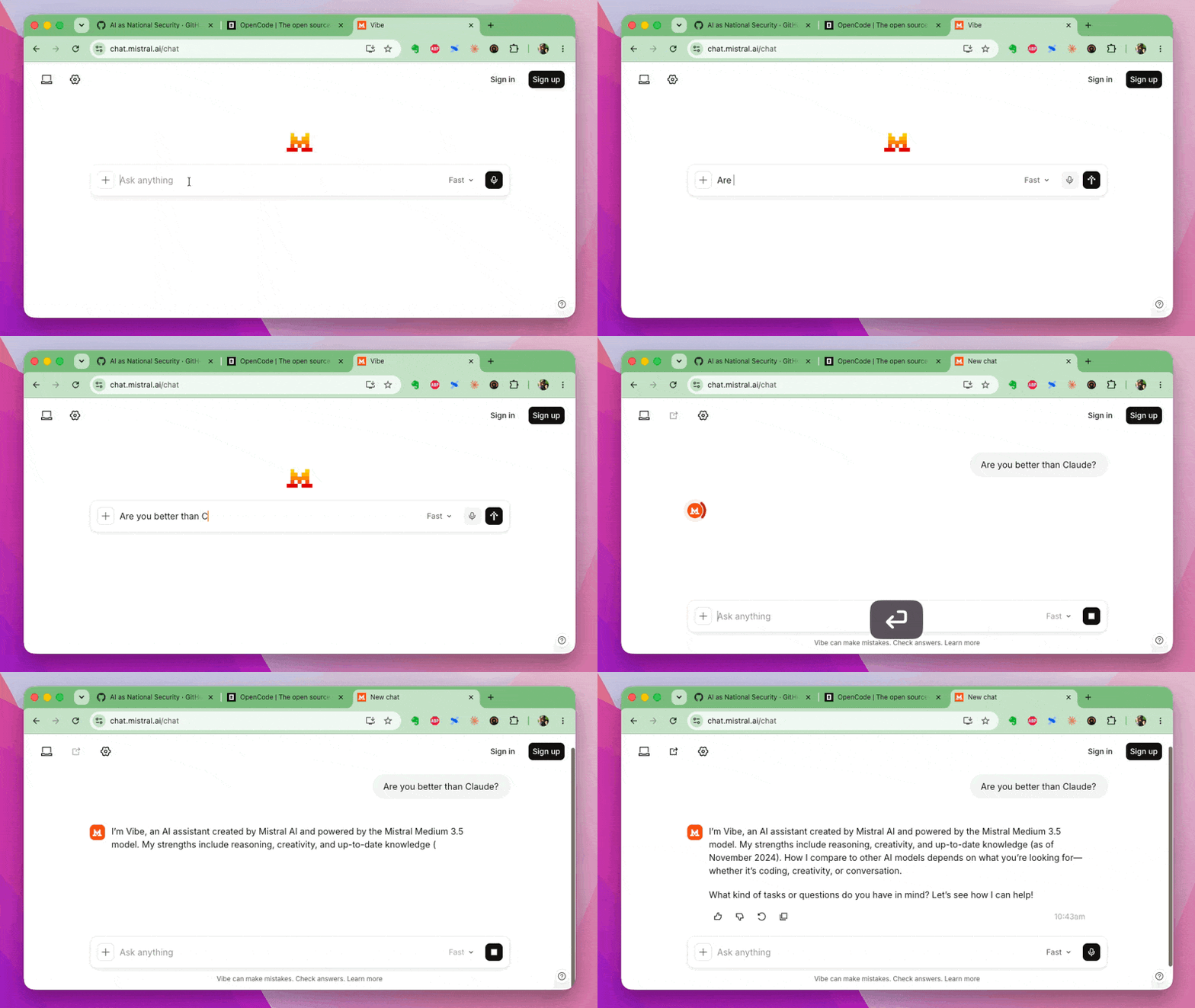
Go to Le Chat. Or Qwen. Or Z.ai. Use the same prompt you would give Claude. See what happens.
Pure experimentation. You’ll see it is worth your time.
The AI companies that have your attention right now are expert at making their tools feel indispensable. That expertise is real. The tools are good. But indispensable is a feeling, not a fact.
There is more room here than you have been led to believe.
Sources and reference material
This article leans on two companion pieces that I kept separate so the main read doesn’t get bogged down in sourcing and tables.
Who Really Controls Your AI? — The US and China Question — the full story behind the Pentagon contract, the Maduro operation, the Iran strike, Dario Amodei’s own words on it, and the documented political bias baked into Chinese open-weight models. Quotes, sources, and links included.
Reference Tables — AI Alternatives for Knowledge Workers — all seven tables from this research: models, interfaces, workflow tools, local runners, knowledge management tools, APIs, and the developer ecosystem. Every entry includes who owns it, where they’re based, and a direct link.
Do you find something I’m missing in the files? I’ll be happy to edit them with the proper credits:
I hope you found this article valuable.
Love,
Jose
Digital Sovereignty is important for everyone. We should explore local models to avoid data exposure. Understanding the differences between open weights and closed systems is crucial. What steps are you taking to ensure your data privacy?
I love the framing of Digital Sovereignty Jose! I’ve been trying to move to a place where I can run all of my models locally and get off the token wheel. Any particular tips for this in your experience?